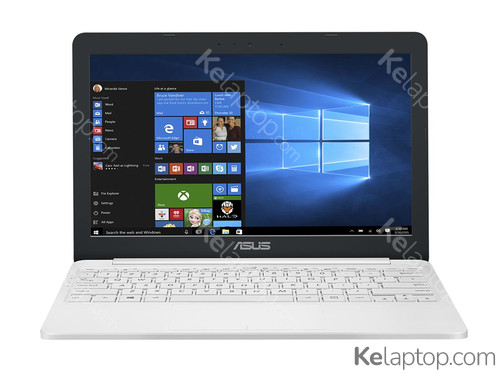
+4
ASUS E203MA-FD078T
Ausstattung
Preise

Haupteigenschaften
| Prozessor | Intel Pentium Silver N5000 1,1GHz |
|---|---|
| Bildschirm | 11.6" 1366x768 60Hz |
| Festplatte | 128GB eMMC |
| RAM | 4GB LPDDR4-SDRAM |
| Betriebssystem | Windows 10 Home |
| Grafik |
Alternativen mit gleicher oder höherer Leistung zu einem ähnlichen oder niedrigeren Preis
Von ASUS

Von anderen Marken

Spezifikationen des ASUS E203MA-FD078T
| Referenznummer / Part Number | E203MA-FD078T |
|---|---|
| Erscheinungsdatum | November 2019, vor 6 Jahren |
Design
| Produkttyp | Laptop |
|---|---|
| Produktfarbe | Weiß |
| Formfaktor | Klappgehäuse |
Bildergalerie


Bildschirm
| Bildschirmdiagonale | 29,5 cm |
|---|---|
| Display-Auflösung | 1366 x 768 Pixel |
| Touchscreen | Nein |
| HD-Typ | HD |
| LED-Hintergrundbeleuchtung | Ja |
| Natives Seitenverhältnis | 16:9 |
| Display-Oberfläche | Glanz |
| Maximale Bildwiederholrate | 60 Hz |
| NTSC Abdeckung (typisch) | 45 % |
Prozessor
| Prozessorfamilie | Intel® Pentium® Silver |
|---|---|
| Prozessorhersteller | Intel |
| Prozessor | N5000 |
| Prozessor-Taktfrequenz | 1,1 GHz |
| Prozessor Boost-Frequenz | 2,7 GHz |
| Prozessor-Threads | 4 |
| Anzahl Prozessorkerne | 4 |
| Prozessor-Cache | 4 MB |
| Prozessor Cache Typ | L3 |
| Prozessorsockel | BGA 1090 |
| Prozessor Lithografie | 14 nm |
| Prozessorbetriebsmodi | 32-bit,64-bit |
| Prozessor Codename | Gemini Lake |
| Stepping | B0 |
| Thermal Design Power (TDP) | 6 W |
| Scenario Design Power (SDP) [Szenarienbildungslösung] | 4,8 W |
| Tjunction | 105 °C |
| Maximale Anzahl der PCI-Express-Lanes | 6 |
| PCI-Express-Slots-Version | 2.0 |
| PCI Express Konfigurationen | 1x4+1x2,2x1+1x2+1x2,4x1 |
Speicher
| Speicherkapazität | 4 GB |
|---|---|
| RAM-Speicher maximal | 4 GB |
| Interner Speichertyp | LPDDR4-SDRAM |
| Speichertaktfrequenz | 2400 MHz |
| Memory Formfaktor | On-board |
Speichermedium
| Gesamtspeicherkapazität | 128 GB |
|---|---|
| Speichermedien | eMMC |
| Optisches Laufwerk - Typ | Nein |
| Flash-Speicher | 128 GB |
| Integrierter Kartenleser | Ja |
| Kompatible Speicherkarten | MicroSD (TransFlash) |
Grafik
| Eingebaute Grafikadapter | Ja |
|---|---|
| Separater Grafikadapter | Nein |
| Separates Grafikkartenmodell | Nicht verfügbar |
| Eingebautes Grafikkartenmodell | Intel® UHD Graphics 605 |
| On-Board-Grafikadapterfamilie | Intel® UHD Graphics |
| On-Board Grafikadapter Basisfrequenz | 200 MHz |
| On-Board Grafikadapter Burstfrequenz | 750 MHz |
| Maximale dynamische Frequenz der On-Board Grafikadapter | 750 MHz |
| Maximaler integrierter Grafik-Adapterspeicher | 8 GB |
| Anzahl der Rechenwerke | 18 |
| On-Board Grafikadapter DirectX Version | 12.0 |
| On-Board Grafikadapter Geräte-ID | 0x3184 |
Audio
| Lautsprecherleistung | 2 W |
|---|---|
| Eingebautes Mikrofon | Ja |
Kamera
| Frontkamera | Ja |
|---|
Netzwerk
| Top WLAN-Standard | Wi-Fi 5 (802.11ac) |
|---|---|
| WLAN | Ja |
| WLAN-Standards | 802.11a,Wi-Fi 5 (802.11ac),802.11b,802.11g,Wi-Fi 4 (802.11n) |
| Ethernet/LAN | Nein |
| Bluetooth | Ja |
| Bluetooth-Version | 4.1 |
Anschlüsse und Schnittstellen
| USB 3.2 Gen 1 (3.1 Gen 1) Anzahl der Anschlüsse vom Typ A | 2 |
|---|---|
| USB 3.2 Gen 1 (3.1 Gen 1) Anzahl der Anschlüsse vom Typ C | 1 |
| Anzahl HDMI-Anschlüsse | 1 |
| Kombinierter Kopfhörer-/Mikrofon-Anschluss | Ja |
| ExpressCard-Slot | Nein |
| SmartCard-Slot | Nein |
Tastatur
| Numerisches Keypad | Nein |
|---|---|
| Eingabegerät | Touchpad |
| Windows Tasten | Ja |
Software
| Installiertes Betriebssystem | Windows 10 Home |
|---|
Prozessor Besonderheiten
| Intel® Anti-Theft Technologie (Intel® AT) | Nein |
|---|---|
| Intel® Smart-Response-Technologie | Nein |
| Intel® Identity-Protection-Technologie (Intel® IPT) | Ja |
| Intel® Hyper-Threading-Technik (Intel® HT Technology) | Nein |
| Intel® Turbo-Boost-Technologie | Nein |
| Verbesserte Intel SpeedStep Technologie | Ja |
| Intel® Quick-Sync-Video-Technik | Ja |
| Intel® AES New Instructions (Intel® AES-NI) | Ja |
| Intel® Enhanced Halt State | Ja |
| Intel® VT-x mit Extended Page Tables (EPT) | Ja |
| Intel® Sicherer Schlüssel | Ja |
| Intel® OS Guard | Ja |
| Intel® Software Guard Extensions (Intel® SGX) | Ja |
| Intel® 64 | Ja |
| Execute Disable Bit | Ja |
| Leerlauf Zustände | Ja |
| Thermal-Überwachungstechnologien | Ja |
| Prozessor-Paketgröße | 25 x 24 mm |
| Prozessor-Code | SR3RZ |
| CPU Konfiguration (max) | 1 |
| Eingebettete Optionen verfügbar | Nein |
| UART | Ja |
| Intel® Virtualisierungstechnik für direkte I/O (VT-d) | Ja |
| Intel® Identity Protection Technologieversion | 1.00 |
| Intel® Smart Response Technologieversion | 0.00 |
| Intel® Secure Key Technologieversion | 1.00 |
| Intel® Virtualization Technologie (VT-X) | Ja |
| ARK Prozessorerkennung | 128990 |
| Konfliktloser-Prozessor | Ja |
Akku/Batterie
| Batteriekapazität | 38 Wh |
|---|---|
| Akku-/Batterietechnologie | Lithium Polymer (LiPo) |
| Anzahl Batteriezellen | 2 |
Energie
| Netzteilstärke | 33 W |
|---|---|
| Netzteilfrequenz | 50 - 60 Hz |
| Netzteil Eingansgsspannung | 100 - 240 V |
| AC-Adapter Ausgangssstrom | 1,75 A |
| Netzteil Ausgangsspannung | 19 V |
Gewicht und Abmessungen
| Gewicht | 990 g |
|---|---|
| Breite | 286 mm |
| Tiefe | 193,3 mm |
| Höhe | 16,9 mm |
Sonstige Funktionen
| AC-Netzadapter | Ja |
|---|
Häufige Fragen
Eignet sich das ASUS E203MA-FD078T zum Spielen?
Dieser Laptop wurde nicht zum Spielen gebaut: Er setzt auf die integrierte Intel UHD Graphics 605. Auf ihrer Seite steht, auf welchem Niveau sie aktuelle Spiele stemmt.
Wie ist das Display des ASUS E203MA-FD078T?
Es trägt ein Display mit 11.6" 1366x768 60Hz.
Welchen Prozessor und welche Grafikkarte hat das ASUS E203MA-FD078T?
Es läuft mit dem Prozessor Intel Pentium Silver N5000 und der Grafik Intel UHD Graphics 605. Auf ihren Seiten stehen Benchmarks, Ranking-Position und Alternativen.
Mit welchem Betriebssystem kommt das ASUS E203MA-FD078T?
Es kommt mit vorinstalliertem Windows 10 Home.
Welche Anschlüsse hat das ASUS E203MA-FD078T?
Laut Datenblatt: 1 × USB-C, 2 × USB-A, 1 × HDMI, Kartenleser, Kopfhöreranschluss (3,5 mm).
Hat das ASUS E203MA-FD078T einen Touchscreen?
Nein, laut Datenblatt ist das Display kein Touchscreen.
Wie viel wiegt das ASUS E203MA-FD078T?
Es wiegt 990 g.
Wann kam das ASUS E203MA-FD078T heraus?
Sein Erscheinungsdatum ist November 2019, vor 6 Jahren.